April 30, 2026
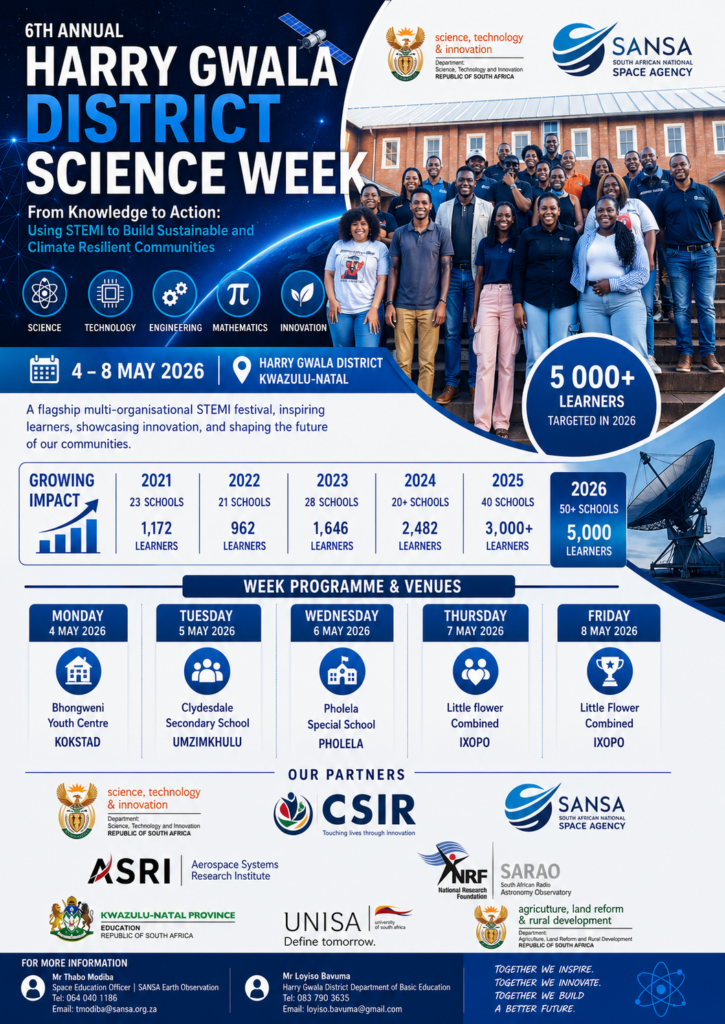
For the sixth consecutive year, the South African National Space Agency (SANSA) will once again host a science week at the Harry Gwala District in KwaZulu-Natal. It will take place from 4 to 8 May 2026 and preparations are well underway. Organised by SANSA in partnership with the Harry Gwala District Department of Basic Education, this year’s edition is set to be the largest in the programme’s history. Organisers are expecting to reach more than 5 000 learners from over 50 schools across the District, a significant expansion from the 3 000 learners and 40 schools reached in 2025.
The 2026 edition will extend into new territory, with the Mt Currie and Samaria Circuits joining the returning venues of Kokstad, Mzimkhulu, Ixopo, and Pholela. New organisations from additional STEMI (Science, Technology, Engineering, Mathematics and Innovation) sectors are being brought into the partnership, broadening the range of career pathways and scientific disciplines on offer. The Grade 12 competition, introduced in 2025 to considerable enthusiasm, will return in an enhanced form with expanded prizes and structured subthemes tied directly to the year’s overarching topic.
The theme for 2026 is “From Knowledge to Action: Using STEMI to Build Sustainable and Climate Resilient Communities.” It marks a deliberate progression from previous years, moving beyond introducing learners to the world of science and challenging them instead to apply what they know to the real problems their communities face. Competition subthemes will focus on climate adaptation, disaster preparedness, and sustainable economic growth, giving learners concrete and meaningful problems to engage with using the science they have built both in school and through the Science Week itself.
The proposed 2026 schedule runs across five days. Monday, 4 May will be held in Kokstad, covering the Mt Currie and Samaria Circuits. Tuesday, 5 May moves to Mzimkhulu, followed by Ixopo on Wednesday, 6 May. Thursday, 7 May returns to Pholela, and the week closes on Friday, 8 May with the Competition and Awards Day at a venue still to be confirmed.
The foundation for 2026 was laid by the 5th Harry Gwala District Science Week in 2025 with the theme “Building Resilient Communities: Tackling Environmental Challenges and Driving Sustainable Development.” Nine organisations participated, including SANSA, DSTI dsti.gov.za, CSIR Home | CSIR, ASRI (UKZN)Home – Aerospace Systems Research Institute (ASRI), NRF-SAAO SAAO – National Research Foundation, NRF-SARAO , NECSA Necsa – South African Nuclear Energy Corporation (Necsa) , UNISA Robotics Home , and DALRRD Department of Agriculture – The Department Of Agriculture, Land Reform and Rural Development.
Since 2021, the programme has grown from 1 172 learners at 23 schools to over 3 000 learners at 40 schools in 2025, with partner organisations expanding from one to nine. Across all five editions, the programme has cumulatively engaged more than 9,262 learners from across the district. KwaZulu-Natal’s 90.60% matric pass rate in the 2025 cohort reflects, in part, this sustained investment in rural STEMI engagement.
Many of the schools the Science Week reaches lack laboratories, reliable internet, and up-to-date science materials. The programme brings world-class STEMI exhibitions directly to these communities, placing real scientists and engineers, many from similar rural backgrounds, in front of learners as living proof that these careers are within reach. Topics covered include AI, robotics, satellite data, disaster management, biodiversity, renewable energy, and nuclear science. All current and prospective partner organisations are invited to join the 6th Harry Gwala District Science Week from 4 to 8 May 2026. Together, the growing coalition continues to light the spark of scientific curiosity across the hills and valleys of Harry Gwala District.