
February 11, 2026
The South African government is moving toward a coordinated national approach to satellite imagery procurement in a strategic effort expected to significantly reduce costs, strengthen data sovereignty, and enhance evidence-based planning across the public sector.
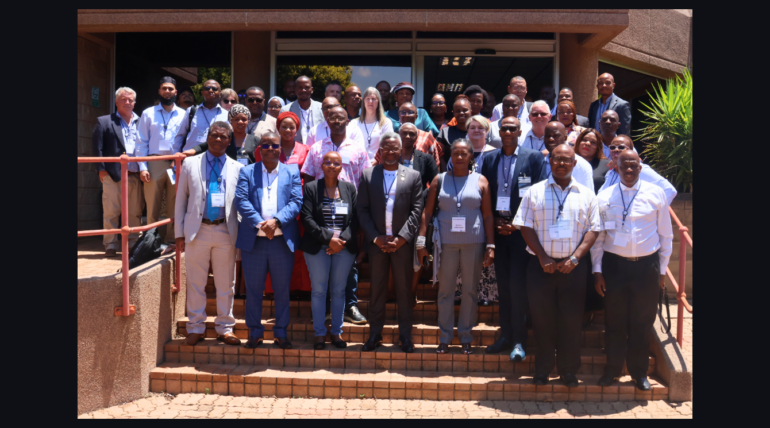
The initiative, led by the Department of Science, Technology and Innovation and supported by the South African National Space Agency (SANSA), was advanced during a high-level interdepartmental workshop held at SANSA’s Hartebeesthoek facility. The session brought together key government stakeholders to align on positioning SANSA as the sole provider for satellite images
Delivering the keynote address, Dr. Kenny Tenza, the Deputy Director-General of the Department of Science, Technology and Innovation (DSTI) called on stakeholders to fully recognise SANSA as a national asset capable of delivering measurable value.
“We must come out of this workshop compelled or convicted about the value of using SANSA as a national asset. SANSA must be a call away for satellite data and imagery for all who need it,” the DDG said.
A proven model with measurable savings
Central to the discussions was the revival of a single-license, multi-user data acquisition model that allows government departments and entities to procure and share high-resolution satellite imagery through a cost-sharing framework.
This approach aligns South Africa with global best practice, as similar models are successfully implemented by international bodies and alliances such as the European Union (EU), the United Nations Office for Outer Space Affairs (UNOOSA), and BRICS partners to acquire high spatial resolution imagery.
Dr Nale Mudau, SANSA Data Products and Services Manager and project lead for the government multi-user licence initiative, traced the origins of the approach in South Africa and highlighted its proven benefits.
“In 2006, SANSA established a government multi-user data acquisition model in collaboration with key national stakeholders to access high spatial resolution images that address the data requirements of multiple departments and entities. More than 200 government departments, entities and municipalities benefited from the model,” she said.
“The multi-user initiative could save government entities approximately R88 million in data acquisition costs in comparison to using a single license agreement”.
Dr Mudau emphasised that resuscitating the multi-user agreement is critical to strengthening the country’s data sovereignty.
“It will enable South Africa to control its narrative on issues relating to human settlement, environmental management, disaster risk reduction and other satellite data-driven areas,” she added.
Enabling smarter government planning
In his opening remarks, SANSA Chief Executive Officer, Humbulani Mudau, highlighted the strategic importance of adopting a unified national framework and reiterated the workshop outcomes which included:
- Reinforced understanding of SANSA’s mandate and the National Treasury directive issued in 2018
- Agreement on a framework for coordinated procurement
- Identification of departmental focal points for sustained collaboration
- Commitment to develop an implementation roadmap
Beyond cost efficiency, the multi-user model is expected to expand access to value-added products, provide full national coverage, support human capital development, and strengthen South Africa’s Earth observation ecosystem. By contrast, fragmented procurement processes often limit imagery to single-organisation use, exclude value-added products, and introduce complex supply chain requirements.
The session was attended by representatives from the Municipal Demarcation Board, DSTI, National Treasury, the Department of Planning, Monitoring and Evaluation, the Department of Public Works and Infrastructure, the Department of Human Settlements, the Department of Agriculture, the Department of Water and Sanitation, the State Security Agency, Independent Electoral Commission, National Disaster Management Centre, ESKOM and Statistics South Africa.
A strategic national capability
The move signals growing recognition of space-based technologies as critical infrastructure for modern governance, supporting applications ranging from infrastructure development and service delivery to disaster management and environmental monitoring.
As government advances the implementation roadmap, SANSA is poised to play a central role in ensuring that satellite data is accessible, affordable and strategically leveraged to support South Africa’s development priorities.