
November 17, 2026
Background
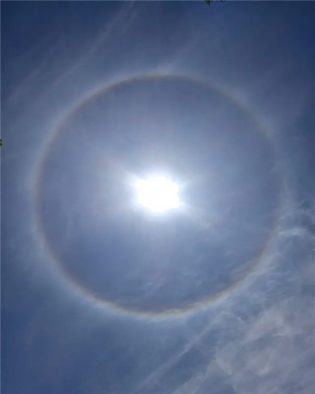
Many people in parts of South Africa recently observed an unusual and beautiful phenomenon in the sky, naturally raising questions about what they were seeing, how it occurs and whether it poses any danger. The phenomenon is known as a Solar Halo, or Sun Halo. Below is some information to explain this interesting atmospheric occurrence.
What is it?
A solar halo is a large, bright, circular ring of light that appears around the Sun. It can sometimes look like a rainbow-coloured circle, with subtle colours ranging from red on the inside to blue or violet on the outside. Although it may look unusual, it is a natural optical phenomenon that occurs in our atmosphere.
What causes it?
A solar halo is caused by sunlight passing through and being refracted (bent) by tiny ice crystals suspended in thin, high-altitude cirrus clouds. These ice crystals act like millions of tiny prisms, bending and redirecting the sunlight to create the circular ring we see around the Sun.The phenomenon is not limited to daylight. A similar halo can also form around the Moon when the right atmospheric conditions are present. These are commonly referred to as lunar halos.
Is it harmful?
No, the solar halo itself is not harmful to people, animals or the environment.
It is simply the result of sunlight interacting with ice crystals high in the atmosphere.However, it is important to remember that the Sun can cause serious and permanent eye damage if viewed directly, even when a halo is visible. Please do not look directly at the Sun, use binoculars or telescopes to observe it, or attempt to photograph it through optical equipment without appropriate solar protection.
The halo can be safely appreciated by looking at the surrounding sky without staring at the Sun.
Why can’t I see it where I am?
A solar halo is a regional atmospheric phenomenon and is not necessarily visible everywhere at the same time.
Its visibility depends on several factors, including the presence and distribution of high-altitude cirrus clouds, the concentration and orientation of ice crystals, local atmospheric conditions and cloud cover. This means that while people in one part of South Africa may observe a clearly defined halo, others just a few kilometres away may not see anything at all. The conditions simply may not be suitable in their particular location.
A fascinating atmospheric phenomenon
Solar and lunar halos are wonderful examples of how light interacts with our atmosphere. What may initially appear to be an unusual occurrence is actually a well-understood natural phenomenon and a reminder of the fascinating science taking place above us every day.