
May 21, 2026
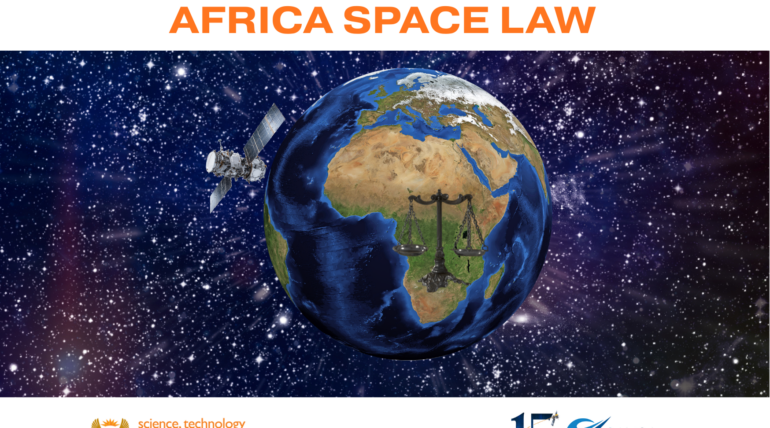
May is Africa Month — a time to celebrate the continent’s rich heritage, its collective achievements, and, increasingly, its ambitions beyond the horizon of Earth itself. This year, the celebrations carry a distinctly cosmic dimension. Africa’s space sector is entering a defining era, and the legal scaffolding that will govern it is being built.
The African space industry was valued at nearly USD 19.5 billion in 2021 and is projected to grow to over USD 22.6 billion by 2026, according to Space in Africa research. More than 13 African nations have launched satellites, and the continent now employs upwards of 19,000 people in the space economy. Yet for decades, the legal and regulatory architecture to support this growth has lagged behind the engineering. That is changing fast.
A Continental aspiration
For aspiring space nations, legal clarity is not merely administrative: it is the foundation of investor confidence, international cooperation, and space sovereignty. Bridging international obligations of the 1967 Outer Space Treaty with practical national legislation remains the central challenge for most African states.
This Africa Month, Pretoria is home to two landmark events that together represent the most significant convergence of African space law expertise ever assembled on the continent.
On 28–29 May 2026, the inaugural Africa Space Law & Policy Conference convenes in Pretoria under the theme “Laying Firm Legal Foundations for the Sustainable Development of Africa’s Space Economy.” Hosted by the University of Pretoria’s Department of Public Law in collaboration with McGill University’s Institute of Air and Space Law, and co-hosted by the Department of International Relations and Cooperation (DIRCO), the Department of Trade, Industry & Competition (DTIC), and the South African National Space Agency (SANSA), the conference brings together policymakers, legal practitioners, academics, and industry leaders to explore how international, regional, and national legal frameworks can underpin sustainable growth in Africa’s rapidly evolving space landscape.
Running ahead of this conference is the 2026 Africa Round of the Manfred Lachs Space Law Moot Court Competition — the premier international capacity-building programme of the International Institute of Space Law (IISL). This year’s competition is hosted by the Department of Trade, Industry and Competition, in partnership with SANSA. Students from universities across Nigeria, Kenya, Uganda, Zimbabwe, and South Africa are competing before distinguished judges — including Justice Daniel Musinga of Kenya and Professor Andrea Harrington of Canada — debating a hypothetical case on liability and responsibility for the space activities of non-governmental corporate actors. The winner will represent Africa at the World Finals during the International Astronautical Congress in Antalya, Turkey in October 2026.
Building Government and Industry Capability
South Africa’s presence at the centre of both events is no accident. The South African National Space Agency and the Department of Science, Technology and Innovation are deliberately building government and industry capability by placing space science and technology at the heart of decision-making and policy formation — ensuring that space is not merely an aspiration but an operational instrument of national development.
SANSA’s mandate — to promote peaceful space use, advance research in space science, develop human capital, and foster industrial growth within the national policy framework — directly supports this mission. Its contributions span Earth observation for flood and fire management, hosting Africa’s only Space Weather Regional Warning Centre, supporting international Deep Space Missions from South African soil, and anchoring the development of South Africa’s future satellites and space infrastructure. These are not peripheral activities; they are the foundations of a data-driven, scientifically informed state.
The Law as Launchpad
What this Africa Month makes clear is that the continent’s space future will be significant not only in orbit, but in legislation, courtrooms, and conference halls. Space law is a development strategy. As African Space Agencies deepen their legal expertise, the continent is constructing the regulatory confidence that transforms satellites into solutions.
Africa Month 2026 is a fitting moment to recognise that Africa is no longer waiting to participate in the space age. It is writing the rules.