January 19, 2026
UPDATE at 10:00 on Wednesday, 21 January 2026
Global geomagnetic conditions were at G2/Moderate to G4/Severe storm levels (Kp 6-8) in the past 24 hours with a G4/Severe storm at about 02:00 (South African Standard Time) this morning.
Storm conditions are expected to remain at strong levels today (21 January 2026) at G1/Minor to G3/Strong levels (Kp 5-7), with a slight chance of G4/Severe (Kp 8) storm intervals due to the ongoing Coronal Mass Ejection (CME) impact and strong solar wind. Solar wind speed is expected to gradually decline from today.
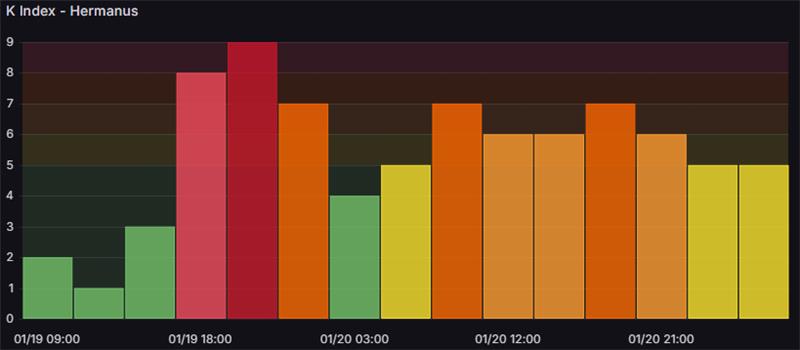
Image: The local Hermanus K-index shows the elevated storm levels since 19 January 2026.
UPDATE at 11:45 on 20 January 2026
The South African National Space Agency continues to track the arrival of a Coronal Mass Ejection (CME) produced by a long-duration X1.9 Solar Flare on 18 January 2026. The expected Coronal Mass Ejection (CME) reached Earth on 19 January 2026 at 21:15 South African Standard Time (SAST), earlier than anticipated. The impact resulted in geomagnetic activity reaching G4/Severe storm levels. G2/Moderate storm levels persisted throughout the morning, but jumped to G4/Severe storm levels at 11:18.
Several photographers managed to capture images of the Southern Lights during the G4/Severe storm conditions.
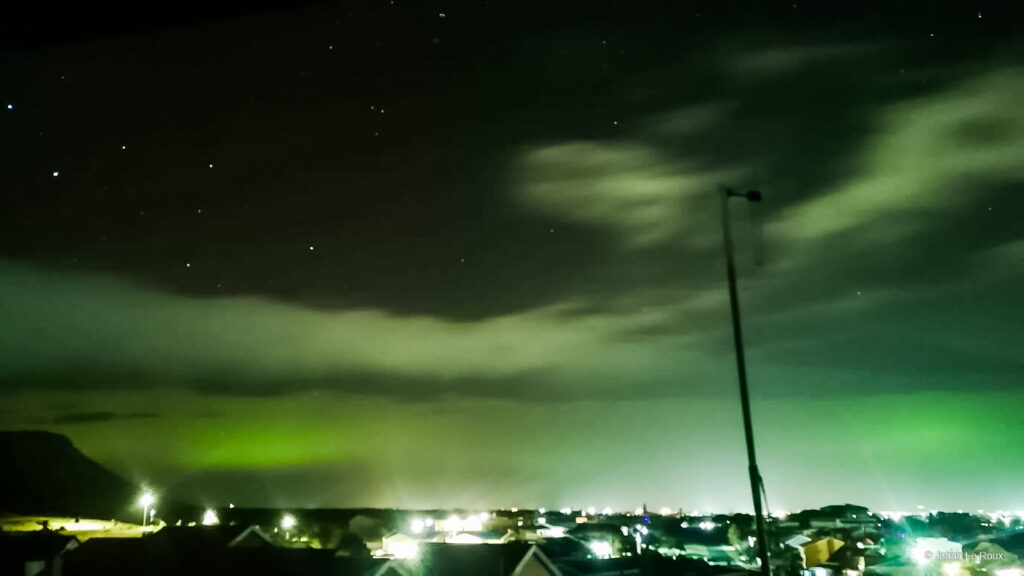
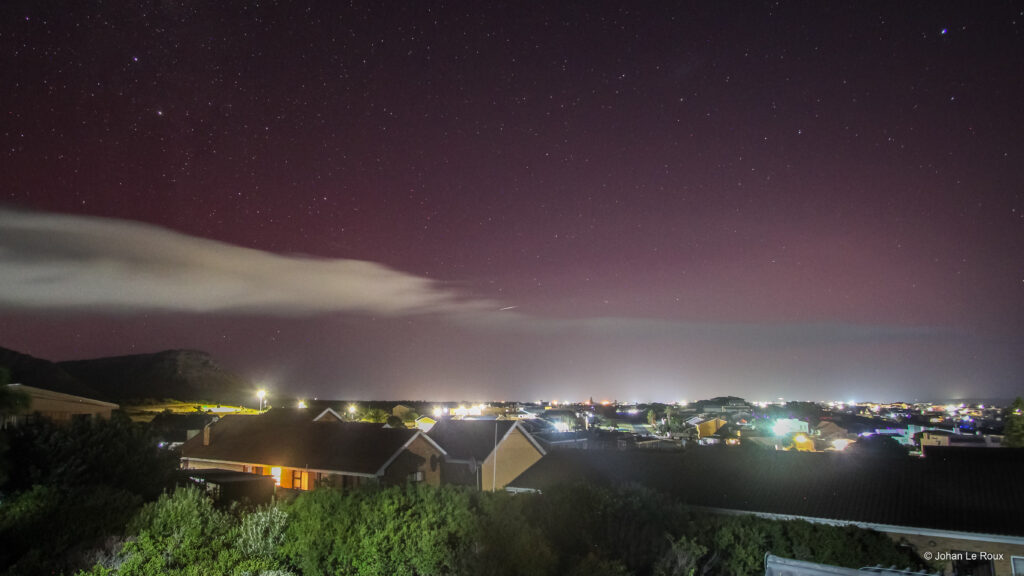
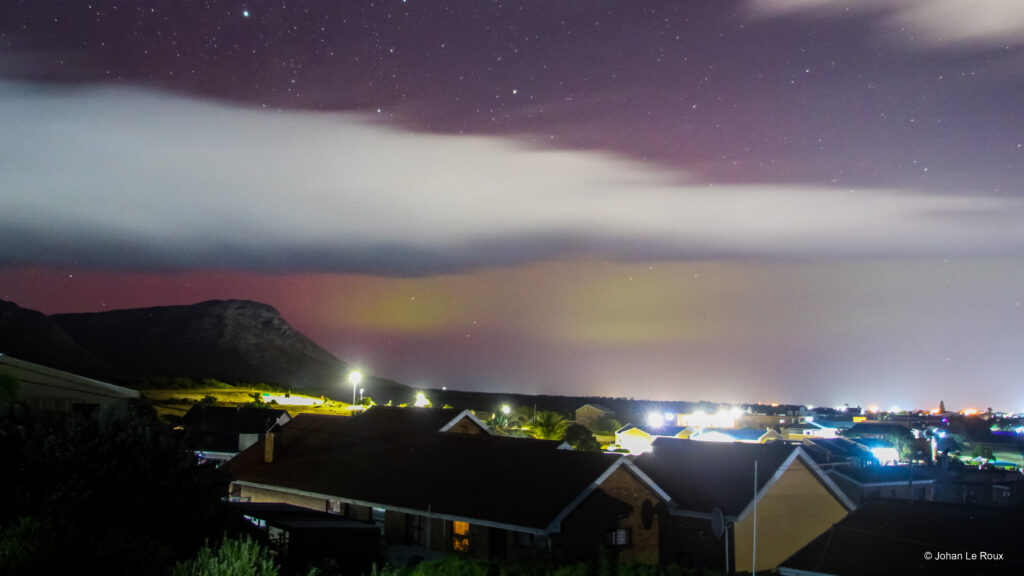
Images: These photos of the Southern Lights were taken by Johan le Roux from Gansbaai in the Western Cape.
Outlook:
Geomagnetic conditions are expected to remain in storm conditions with G1/Minor to G3/Strong storm levels (Kp 5-7) and the possibility of further isolated periods of G4/Severe storm activity (Kp 8).
SANSA monitor the intensity of the geomagnetic storm with real-time data available every three hours. Key indicators like the Planetary K-index provide insight into the storm’s intensity. Industries that experience disruptions in their technological systems during the storm period are encouraged to report this to SANSA for further investigation.
The potential impacts of space weather are:
- Space Radiation Exposure:
This remains a significant concern, particularly for astronauts conducting extravehicular activities (spacewalks). High levels of radiation from solar energetic particles (SEPs) during geomagnetic storms can increase the risk of acute radiation sickness and long-term health issues for astronauts. NASA and other space agencies will be closely monitoring radiation levels to ensure the safety of crew members. - Aviation Impact:
Although the full extent of radiation exposure to aircraft is still being studied, high-altitude flights, particularly those over polar routes, pose an increased risk of exposure to elevated levels of cosmic and solar radiation. Airlines may reroute flights to minimise exposure during peak periods of the storm. - Energy Sector:
Power grids may experience disturbances such as surges or dips caused by geomagnetic induction during the storm. - GNSS (Global Navigation Satellite Systems):
Satellite navigation systems, such as GPS, may experience signal delays or errors as the geomagnetic storm affects the ionosphere, which can lead to inaccuracies in positioning and navigation. This is particularly critical for industries that rely on precise GNSS data, such as aviation, maritime, and agriculture. - Low Earth Orbit (LEO) Satellites:
Based on past events, such as the storm on May 14, 2024, LEO satellites are vulnerable to increased atmospheric drag due to geomagnetic storms, which can cause their orbits to degrade. These satellites may need to perform corrective manoeuvres to avoid deorbiting. Satellites not “space-hardened” (designed to resist radiation damage) could suffer from failures or damage caused by highly energetic particles.
UPDATE at 23:38 on 19 January 2026
The expected geomagnetic storm has arrived at G4/Severe conditions. The geomagnetic storm is expected to continue throughout tomorrow (Tuesday, 20 January) with G1 to G3 conditions and a possibility of further G4/Severe storm levels.
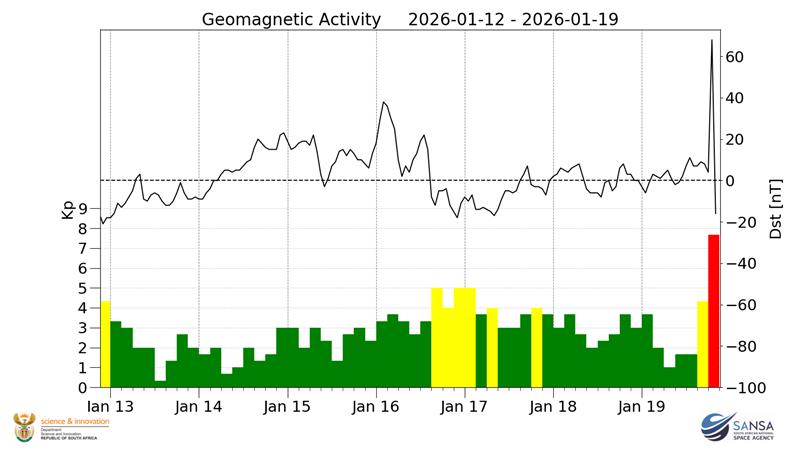
Image: The Planetary K-Index
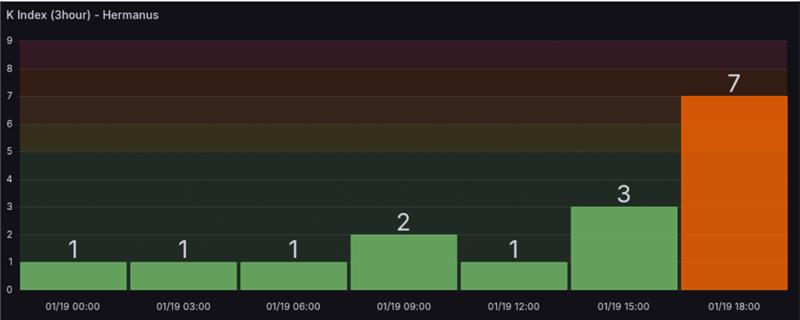
Image: The local Hermanus K-Index.
Elevated Geomagnetic Storm Activity Expected (posted on Monday 19 January 2026)
Geomagnetic storm conditions are expected to increase over the next 24 hours with the arrival of an Earth-directed coronal mass ejection (CME). The CME was triggered by a long-duration X1.9 Solar Flare on Sunday 18 January at around 20:00 South African Standard Time (SAST).
Solar Flare
A Solar Flare is a sudden burst of light from the Sun with an immediate impact on the Earth’s day side, disrupting high-frequency radio communications. Solar Flares are ranked in five categories — A, B, C, M and X — based on their intensity. A-class flares are the weakest, while X-class flares are the most energetic. The African region was not affected by the high-frequency radio blackout on Sunday as it was observed during nighttime, mostly out of the flare’s impact range.
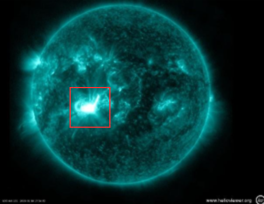
Image 1: The long-duration X1.9 Solar Flare on Sunday 18 January at 18:09 UT (20:09 SAST) from AR4341.
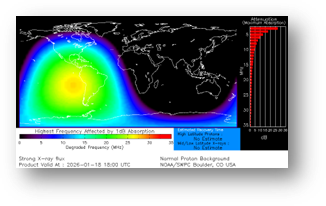
Image 2: On Sunday, the X-class flare caused high-frequency radio disruptions over the Pacific region.
Geomagnetic Storm
The Solar Flare triggered a Coronal Mass Ejection (CME) which is a cloud of plasma released from the sun. This CME is Earth-directed, currently travelling from the Sun to the Earth and expected to impact Earth from the early hours of Tuesday 20 January. This impact will interact with the Earth’s magnetic field and cause a geomagnetic storm. The geomagnetic storm could reach G4/Severe storm conditions.
The G-scale, used by space weather centres globally, categorises geomagnetic storms based on their intensity and potential impact. It ranges from G1 (minor), G2 (moderate), G3 (strong), G4 (severe) and G5 (extreme).
The video shows the Earth-directed coronal mass ejection (CME) triggered by the X1.9 solar flare on Sunday. The disc in the middle of the image blocks the light of the sun, allowing the CME to be observed.
Forecast and Impact of the Geomagnetic Storm
The SANSA Space Weather Centre expect geomagnetic conditions to increase over the next 24 hours:
Expected: G1/Minor to G2/Moderate storms (Kp 5-6)
Likely: G3/Strong storm (Kp 7)
Possible: G4/ Severe storm interval (Kp 8)
Unlike terrestrial storms, geomagnetic storms largely go unnoticed by people because their effects are felt mainly through technological systems. Navigation, communication, and electricity networks are the most at risk. Industries such as aviation and drone operations can be affected by the impact on navigation systems and should take note of the K-Index, a standardised, global measure (0-9) of geomagnetic activity, showing how much the Earth’s magnetic field is disturbed.
SANSA operates a local K-Index from SANSA Hermanus and can be tracked at spaceweather.sansa.org.za.
Monitoring and Tracking space weather
SANSA monitors space weather through its operational 24/7 Space Weather Centre at SANSA in Hermanus, Western Cape and use a network of ground-based instruments over the African continent, the Southern Ocean and Antarctica. SANSA works with space weather centres across the globe to monitor these storms and is accredited by the International Civil Aviation Authority (ICAO) as a regional centre.
SANSA will be updating information throughout the storm period on this post.
For more information on space weather training and monitoring, contact SANSA at spaceweather@sansa.org.za